Life does not always provide straightforward answers. You may be facing uncertainty in your relationship, wondering whether a career change is right for you, or trying to understand a period of personal transformation. Sometimes, you simply want an opportunity to reflect on your circumstances from a different perspective.
This is one reason people explore spiritual and psychic readings. Across different spiritual traditions, readings are used to interpret symbols, explore personal questions, and seek guidance about experiences that may feel difficult to understand.
Some people approach a reading through tarot cards. Others prefer astrology, intuitive readings, mediumship, or spiritual guidance rooted in a particular cultural or religious tradition. Although these practices differ, they often share an interest in reflection, symbolism, and the search for meaning.
At realmagicspellscaster.com, we understand that people approach spiritual services with different questions and expectations. Someone seeking clarity about a complicated love situation may have very different needs from a person considering a business opportunity or looking for direction after a major life change.
However, it is important to understand what a reading can and cannot establish. Psychic and spiritual practices involve beliefs and interpretations that have not been scientifically established as reliable ways of predicting future events or accessing hidden information. A reading should therefore be approached as a spiritual or reflective experience, not as a substitute for professional medical, legal, financial or relationship advice.

In this guide, we explore the meaning of spiritual and psychic readings, popular reading traditions, how consultations work, what questions to ask and how to recognise a responsible practitioner.
What Are Spiritual and Psychic Readings?
Spiritual and psychic readings are consultation practices in which a practitioner offers interpretations, impressions or guidance using a particular spiritual or intuitive approach.
The exact meaning depends on the method being used.
A spiritual reading may explore a person’s beliefs, life experiences, emotional concerns, or sense of purpose. It may involve prayer, reflection, symbolic interpretation, or guidance within a particular spiritual tradition.
A psychic reading is commonly described as an attempt by a practitioner to interpret information through claimed intuitive or extrasensory perception. Practitioners may discuss relationships, career concerns, personal circumstances, or possible future developments.
These descriptions are not interchangeable in every setting. Some readers identify as spiritual practitioners, others describe themselves as psychics, and some offer both types of service.
People may seek a reading because they want to:
- Reflect on an uncertain relationship.
- Explore questions about love and commitment.
- Consider a career or business decision.
- Understand recurring personal concerns.
- Find a sense of direction during a difficult period.
- Explore spiritual beliefs and symbolism.
- Discuss a significant life transition.
- Gain a different perspective on a decision.
A reading does not remove the need to make your own decisions. Its value, for someone who chooses to participate, may lie in the opportunity to reflect, discuss concerns, and consider possible ways forward.
What Is the Difference Between a Spiritual Reading and a Psychic Reading?
Although the terms are sometimes used together, they can describe different approaches.
A spiritual reading generally focuses on spiritual beliefs, personal meaning, inner reflection, or guidance within a particular tradition. The practitioner may use prayer, meditation, symbolic interpretation, or other practices associated with their beliefs.
A psychic reading is more commonly associated with a practitioner’s claimed intuitive impressions or extrasensory perceptions. Depending on the service, the reader may discuss personal circumstances, relationships, or possible future situations.
There can be considerable overlap. For example, a practitioner may combine intuitive interpretation with spiritual reflection during one consultation.
| Feature | Spiritual reading | Psychic reading |
|---|---|---|
| Main focus | Spiritual reflection, meaning and guidance | Claimed intuitive or extrasensory impressions |
| Common methods | Prayer, reflection, spiritual symbolism and tradition-based guidance | Intuitive impressions, cards or other interpretive methods |
| Common topics | Personal growth, purpose, emotional concerns and spiritual beliefs | Relationships, career questions and personal circumstances |
| Approach | Often connected to a spiritual framework | Often presented as intuitive insight |
| Predictive claims | Depend on the practitioner and tradition | May include predictions, which should be treated cautiously |
Neither category has one universal definition. Before booking, ask the practitioner what they mean by the service and how they conduct a session.
7 Popular Types of Spiritual and Psychic Readings
There are several approaches available, and understanding their differences can help you decide which one best matches your interests.
1. Tarot readings
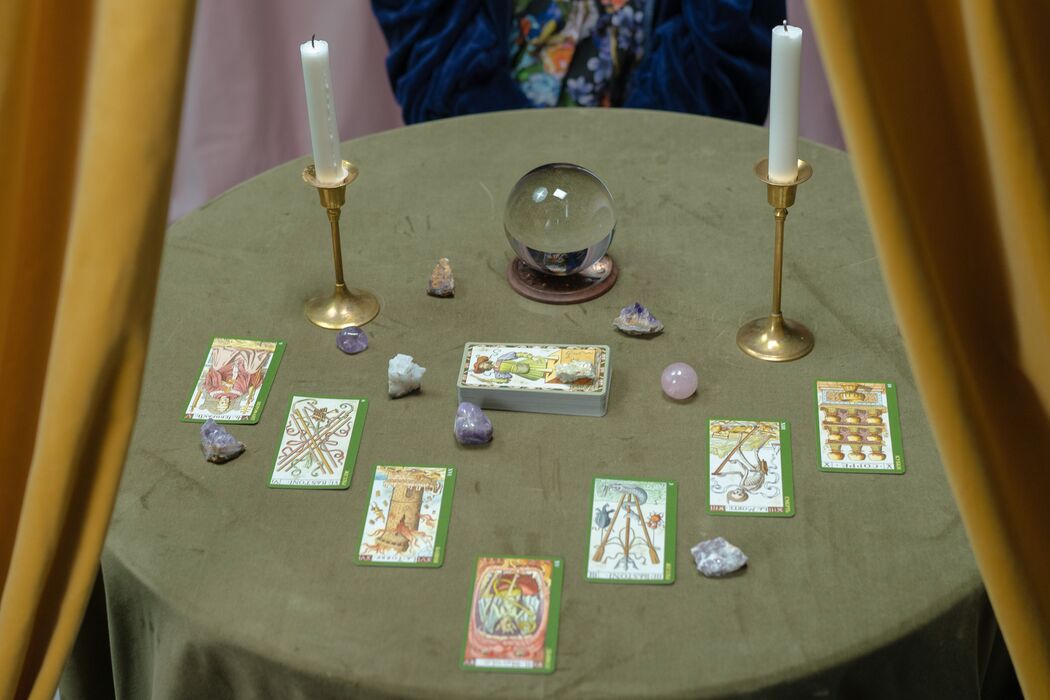
Tarot readings use a deck of cards containing symbolic images and themes. A reader interprets the cards in relation to a question or situation.
Different card positions may represent areas such as the past, present, possible influences, or considerations for the future. The meaning of a card can depend on its position, the surrounding cards, and the reader’s interpretive approach.
People commonly explore tarot readings when thinking about:
- Relationship challenges.
- Personal decisions.
- Career changes.
- Emotional uncertainty.
- New opportunities.
- Personal development.
For example, someone uncertain about whether to continue a relationship might ask for a reading focused on communication, expectations, and personal priorities.
It is helpful to remember that tarot cards do not establish what another person thinks or guarantee what will happen. Their symbolism can instead provide a framework for reflection and conversation.
2. Intuitive readings
Intuitive readings are generally presented as consultations in which a practitioner shares impressions they describe as intuitive.
The approach varies. Some readers speak conversationally, while others incorporate meditation, visualisation or symbolic prompts.
A person might seek an intuitive reading when they feel uncertain about a relationship, a career opportunity or an important personal decision.
If you choose this approach, ask how the practitioner interprets intuitive impressions and whether they distinguish personal opinion from information they believe has a spiritual meaning.
A responsible reader should not pressure you to accept every interpretation as fact.
3. Astrology readings
Astrology readings interpret the positions and movements of celestial bodies through an established symbolic system.
A birth chart reading commonly uses a person’s birth date, time, and location to calculate the positions of planets and other chart features. Different astrological traditions use different methods and interpretive frameworks.
People often explore astrology to reflect on:
- Personality themes.
- Relationship compatibility.
- Personal strengths and challenges.
- Career interests.
- Major life transitions.
- Timing and cycles within an astrological framework.
Astrology is a cultural and symbolic practice rather than a scientifically established method for predicting individual outcomes.
If you are interested in an astrology consultation, ask which tradition the practitioner follows and what information they need. Only share personal details you are comfortable providing.
4. Mediumship readings
Mediumship is a practice in which a practitioner claims to communicate with spirits or deceased people.
People may seek mediumship because they are grieving, curious about spiritual beliefs, or interested in exploring ideas about life after death.
Experiences and interpretations differ widely. Claims of communication with deceased people are not scientifically established, so a session should not be treated as proof that a particular message came from someone who has died.
Grief can make people especially vulnerable to emotional pressure. Be cautious of anyone who claims that you must pay for repeated sessions to protect a deceased loved one, remove a threat, or receive an urgent message.
A compassionate practitioner should respect your feelings and allow you to decide whether the experience is right for you.
5. Love and relationship readings
Love readings focus on questions about romantic relationships, emotional connection, dating, commitment, and relationship decisions.
Someone might seek a love reading after a breakup, during a period of uncertainty, or when considering whether a relationship is meeting their needs.
Common topics include:
- Understanding relationship patterns.
- Reflecting on communication difficulties.
- Considering compatibility.
- Exploring personal expectations.
- Thinking about reconciliation.
- Preparing for a new relationship.
A love reading cannot reliably establish another person’s private thoughts or guarantee that an ex-partner will return. It should not be used to justify unwanted contact or attempts to override another person’s boundaries.
For people seeking more specialised guidance, our guide to online love spell consultation explores a different type of spiritual service and what to consider before booking.
6. Career and business readings
Career and business readings explore questions connected with work, professional direction and commercial aspirations.
A person may be considering a new job, planning a business, feeling dissatisfied with their current role, or deciding whether to pursue an opportunity.
A reading may provide a structured opportunity to reflect on questions such as:
- What professional goals matter most to me?
- What concerns are holding me back?
- Am I prepared for a change?
- Which skills should I develop?
- What practical steps could move my plans forward?
Spiritual interpretation should not replace research, financial planning, or professional advice. If a decision involves significant money or contractual obligations, examine the practical evidence before committing.
7. General spiritual guidance readings
General spiritual guidance readings may combine several interpretive approaches according to the practitioner’s tradition.
A session could focus on personal beliefs, emotional experiences, life direction, or the meaning a person attaches to a particular situation.
Some people prefer this format because they do not have one specific question. They may simply want to discuss what has been happening and reflect on their next steps.
Ask the practitioner what the session includes, whether they use a particular method, and how they approach questions outside their area of experience.
What Questions Can You Ask During a Spiritual or Psychic Reading?
Preparing a few questions can make a consultation more focused.
You do not need to arrive with every detail of your life prepared. It is usually enough to identify the issue you want to explore and think about what kind of discussion would be useful.
Questions about love and relationships
If your main concern is romantic love, you might ask:
- What relationship patterns should I reflect on?
- What do I need from a healthy relationship?
- How can I communicate my expectations more clearly?
- What have I learned from my previous relationships?
- What should I consider before pursuing reconciliation?
- How can I establish healthier emotional boundaries?
These questions focus on your experiences and choices rather than assuming a reading can reveal another person’s private thoughts.
Questions about career and finances
If you are thinking about your professional future, consider:
- What matters most to me in my next career move?
- Which skills should I focus on developing?
- What practical concerns should I examine before changing jobs?
- How can I become more confident about my professional goals?
- What should I consider before starting a business?
Avoid relying on a reading as the sole basis for investment, borrowing, employment, or financial decisions.
Questions about personal growth
For a broader reflective session, you could ask:
- What personal habits would I like to change?
- What do I want my next chapter to look like?
- Which boundaries are important to my wellbeing?
- How can I respond more constructively to uncertainty?
- What would help me feel more grounded?
The best questions are those that help you think clearly rather than make you feel dependent on a practitioner’s answers.
How Does a Spiritual or Psychic Reading Session Work?
There is no universal process, but many consultations follow a similar structure.
Understanding the typical stages can help you know what to expect.
Step 1: Choosing the reading type
The first step is identifying the service you want.
You might choose tarot, astrology, intuitive guidance, mediumship, or another approach. If you are unsure, ask the practitioner to explain the available options before booking.
Step 2: Arranging the appointment
Depending on the service, appointments may take place in person, over the telephone, or through an online platform.
Confirm the appointment length, price, payment arrangements, and any information required before the session begins.
Step 3: Explaining your question
The practitioner may ask what you would like to discuss.
You can provide a brief explanation without sharing information that feels too private. You should never feel pressured to disclose passwords, financial account details, or unnecessary identifying information.
Step 4: The reading itself
The practitioner follows their chosen method and shares interpretations or impressions.
Depending on the service, this may involve cards, an astrological chart, conversation, spiritual reflection or another form of symbolic interpretation.
You can ask for clarification if something is unclear. You can also disagree with an interpretation.
Step 5: Discussing the guidance
At the end of the session, you may have an opportunity to discuss what stood out to you.
Take time to consider the information rather than feeling obliged to make an immediate decision.
Step 6: Deciding what to do next
You remain responsible for your own choices.
You may decide to take practical action, seek a different professional opinion, reflect further, or simply leave the session without making any immediate changes.
A reading should not create pressure to purchase additional services.

Online Spiritual and Psychic Readings: What Should You Know?
Online consultations make it possible to speak with practitioners without travelling to a physical location.
They may take place through video calls, telephone conversations, messaging platforms, or other agreed communication methods.
For some people, online sessions offer convenience and privacy. They can also make it easier to arrange appointments across different time zones.
Before booking an online reading, consider the following.
Communication method: Confirm whether the appointment is by video, telephone, or written messages.
Appointment length: Ask how long the session will last and whether the time includes introductory discussion.
Privacy: Find out how your personal information and any session recordings are handled.
Payment: Confirm the total price and whether any additional charges apply.
Preparation: Ask whether you need to provide a birth date, birth time, or other information.
Follow-up: Check whether follow-up questions are included or charged separately.
Cancellation: Understand the cancellation and refund arrangements before paying.
If you are comparing online spiritual services, our article on online love spell consultation provides further guidance about remote appointments, preparation, and choosing a service.
How Should You Prepare for a Psychic Reading?
A little preparation can help you make better use of the time.
Identify your main concern
Think about the subject you want to discuss. It could be a relationship, career decision, personal transition or spiritual question.
You do not need to prepare a long explanation. A clear starting point is often enough.
Write down a few questions
Prepare two or three questions that reflect what you genuinely want to understand.
This can help you avoid leaving the session feeling that you forgot the issue that mattered most.
Keep an open but thoughtful mind
You can listen to an interpretation without automatically accepting it.
Consider whether the discussion is useful, reasonable, and relevant to your circumstances.
Set personal boundaries
Decide in advance what information you are comfortable sharing.
You can decline to answer questions that feel intrusive or unrelated to the service.
Avoid booking under pressure
If you are frightened, upset, or feeling desperate for an answer, take time to decide whether a reading is appropriate.
A responsible practitioner should not insist that you pay immediately or claim that something terrible will happen if you delay.
Can Psychic Readings Predict the Future?
Many psychic practitioners describe their services as offering insight into possible future developments. Some may discuss predictions, while others focus on present circumstances or personal reflection.
However, there is no reliable scientific evidence that psychic readings can consistently predict an individual’s future.
Life is influenced by many factors, including personal decisions, other people’s choices, changing circumstances, and events that cannot be known in advance.
For this reason, treat predictions as interpretations or beliefs rather than established facts.
If a reader suggests that a particular event will definitely happen, consider whether that claim is realistic. Be especially cautious if the prediction is used to frighten you or persuade you to purchase another service.
A useful reading should leave room for your judgement and personal responsibility.
Are Spiritual and Psychic Readings Accurate?
Accuracy depends on what is being assessed.
A reading may contain general observations, symbolic interpretations or statements that feel relevant to the person receiving it. That experience can be meaningful, but it does not establish that the practitioner has accessed hidden information or supernatural knowledge.
People may interpret the same reading differently. Personal expectations, memory, and the way questions are framed can also influence how a session is experienced.
It is therefore sensible to consider a reading as one perspective rather than a definitive account of your life.
Results differ for each individual in how they experience and interpret spiritual consultations. Avoid practitioners who claim that every reading will provide exact answers or produce a guaranteed result.
How Much Do Spiritual and Psychic Readings Cost?
Prices vary depending on the practitioner, reading method, appointment length, location, and format.
A short introductory consultation may cost less than a longer session involving detailed preparation. Astrology readings, for example, may require chart calculations and additional discussion, while some tarot consultations are arranged around a fixed appointment period.
Before paying, ask:
- What is the full cost?
- How long will the session last?
- What does the fee include?
- Are follow-up questions charged separately?
- Is a deposit required?
- What is the cancellation policy?
- Are refunds available if the appointment does not take place?
Avoid making financial decisions while under emotional pressure.
Be particularly cautious if someone repeatedly increases the price after telling you that a serious spiritual problem has been discovered. Claims that you must pay more to prevent harm or remove an urgent threat are important warning signs.
How to Choose a Trustworthy Spiritual or Psychic Reader
Choosing a practitioner requires more than finding someone who makes confident claims.
Look for clear information, respectful communication, and transparent service arrangements.
1. Check the practitioner’s explanation of their service
A practitioner should be able to explain whether they offer tarot, astrology, intuitive guidance, mediumship or another form of reading.
Be cautious if the service is described in vague terms and the practitioner cannot explain what happens during an appointment.
2. Look for transparent pricing
The cost should be clear before you book.
Ask about deposits, additional charges, and follow-up fees. You should not have to discover unexpected costs after the session has started.
3. Avoid absolute promises
Be cautious of claims that a practitioner can guarantee a relationship outcome, predict every event, or provide certain knowledge about another person’s private thoughts.
Spiritual readings involve interpretation and belief. They should not be presented as infallible evidence.
4. Protect your privacy
Only share information that is necessary for the service and that you are comfortable providing.
Do not provide passwords, banking credentials, security codes, or access to private accounts.
5. Watch for fear-based selling
A practitioner should not threaten you with curses, spiritual attacks, or misfortune if you decline additional services.
You should be free to ask questions, take time to decide, and end the consultation.
6. Consider the practitioner’s approach to personal boundaries
A responsible reader should respect your right to disagree, decline a recommendation or stop the session.
They should also avoid encouraging harassment, unwanted contact or attempts to control another person’s choices.
For a more detailed checklist, see our planned guide to how to evaluate a love spell caster.
Spiritual Readings for Love, Career and Personal Direction
Different people seek readings for different reasons. The subject of the consultation should shape the questions you ask and the type of guidance you choose.
Spiritual readings for love
Relationship uncertainty can be emotionally demanding. You may be questioning whether to reconcile, trying to understand a communication problem or thinking about what you need from a future partner.
A reading may provide an opportunity to reflect on these concerns.
Useful areas of discussion include communication, compatibility, personal expectations, and emotional boundaries.
A reading should not be treated as proof that someone secretly loves you or as permission to disregard their wishes.
Spiritual readings for career decisions
Career changes often involve uncertainty about income, professional development, and long-term goals.
A reading may offer a reflective setting in which to consider what you want from your working life.
However, compare job opportunities carefully, research employers and review financial implications before making a decision.
Spiritual readings for personal growth
Some people do not have one urgent problem. They simply want to explore their beliefs, values, and priorities.
A general spiritual reading may provide a structured opportunity to consider what matters to them and how they want to approach the next stage of life.
Personal growth is not a fixed destination. It involves ongoing reflection and practical choices.
When Is a Psychic Reading Not the Right Choice?
A reading may not be appropriate in every situation.
If you are facing an immediate safety concern, medical problem, serious financial decision, or legal dispute, seek the relevant professional support rather than relying on a spiritual consultation.
You should also reconsider a reading if:
- You feel pressured to book immediately.
- You are being told that something terrible will happen unless you pay.
- The practitioner refuses to explain their fees.
- You are expected to disclose passwords or sensitive financial information.
- You are encouraged to stop prescribed treatment or ignore professional advice.
- The session increases your distress or fear.
- You feel unable to make decisions without repeatedly consulting the same reader.
Spiritual exploration should leave you free to think, question, and decide. It should not make you feel frightened or dependent.

Frequently Asked Questions About Spiritual and Psychic Readings
1. What are spiritual and psychic readings?
Spiritual and psychic readings are consultations in which practitioners offer guidance or interpretations through spiritual, symbolic or claimed intuitive methods. Common approaches include tarot, astrology, mediumship, and general spiritual guidance.
2. What is the difference between a psychic and a spiritual reader?
A psychic reader commonly describes their work in terms of claimed intuitive or extrasensory impressions. A spiritual reader may focus more broadly on spiritual beliefs, symbolism, reflection, and guidance within a particular tradition. Some practitioners offer both.
3. What types of psychic readings are available?
Popular types include tarot readings, intuitive readings, astrology readings, mediumship, love readings, and career readings. The methods and interpretations vary between practitioners.
4. Can a psychic reading tell me whether my ex will return?
A reading may explore your feelings about reconciliation, relationship patterns, and possible choices. However, it cannot reliably establish what another person will decide or guarantee that an ex-partner will return.
5. Are online psychic readings reliable?
Online readings can provide the same type of consultation format as an in-person appointment, depending on the practitioner and method. However, an online format does not prove that psychic claims are accurate. Check the service, fees, and privacy arrangements before booking.
6. How long does a spiritual reading take?
Session lengths vary. Some consultations are brief, while others allow more time for detailed discussion. Confirm the appointment length and what is included before paying.
7. What should I ask during a psychic reading?
Prepare questions about the subject you want to explore. For example, you might ask about relationship patterns, personal priorities, career goals or ways to approach a difficult decision.
8. Can spiritual readings predict the future?
Some practitioners offer predictions, but psychic readings have not been scientifically established as reliable methods of forecasting individual events. Treat predictions as interpretations rather than certain outcomes.
9. Do I need to provide personal information for a reading?
Some methods require limited information. Astrology readings may request birth details, for example. Share only what is necessary and avoid providing passwords, banking details, or other sensitive credentials.
10. How do I choose a good psychic reader?
Look for clear service descriptions, transparent fees, respectful communication, and realistic claims. Avoid practitioners who use fear, urgency, or threats to pressure you into paying for additional services.
Finding Meaning Through Spiritual and Psychic Readings
Spiritual and psychic readings come in many forms, from tarot and astrology to intuitive consultations, mediumship and general spiritual guidance. Each approach has its own methods, traditions, and interpretations.
If you are considering a reading, begin by identifying what you want to explore. Choose a service that matches your interests, ask clear questions, and make sure you understand the fees and privacy arrangements before booking.
At The Den of real magic spells casters, we recognise that people seek spiritual guidance for many different reasons. Whether your concern involves love, career, personal growth or an important life transition, a thoughtful consultation should respect your beliefs, your circumstances and your right to make independent decisions.
Remember that spiritual readings are not a substitute for professional advice, and no practitioner should pressure you with frightening predictions or promises of guaranteed outcomes. Results differ for each individual in how they experience and interpret these practices.
Approach the experience with curiosity, sound judgement and a clear understanding of your own boundaries. Ultimately, the most meaningful guidance is guidance that helps you reflect, consider your choices, and move forward with greater clarity.
Book a Private Consultation Now!
📞 Phone/WhatsApp:+27786430400
💌 Email: [email protected]
🌎 – Global Availability!